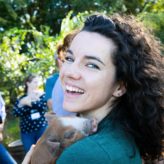
Sea Matías, an urban farmer, had an unconventional childhood in the Bronx, New York. They were raised in nature, with access to the state’s Van Cortlandt State Park. Their grandmother taught them how to identify wild species, instilling an appreciation for the “wonder, curiosity, and magic of plants.” They spent hours in the kitchen together, tending to an avocado tree, making compost tea, and cooking traditional Caribbean dishes.
“I’ve always been a kid who was very different than others in the Bronx. I would get dirty and dig up rocks. I was always outside. I always was curious about nature, plants, how to grow things,” says Matías. “I feel like every moment that I remember with [my grandmother] was eating and trying new things.”
When Matías lost their grandmother in 2017, they felt called to continue her legacy of growing plants and building community through food. Now, Matías takes a community land stewardship approach to farming at Serra Vida Farm in east-central New York. In its first year, using just one acre of regeneratively managed ground, the farm produced nearly 10,000 pounds of food for mutual aid in its local county and the Bronx.
“Farming is very extractive of the nutrients of the soil, and [I try to be] very mindful of how I’m putting back what I’m taking,” Matías tells Food Tank. “Yes, we are farming…but also we are creating an environment. This is an environment that needs to be sustainable, not just to us and the people we feed, but to the plants, the beneficial bugs, the animals that are around us.”
Matías has practiced this philosophy on farms throughout New York State. They completed an urban agriculture certification program at Farm School NYC and began an apprenticeship with Morning Glory Garden in the Bronx. On a quarter-acre of land, Matías learned how to make the most of small spaces, using drip irrigation, rain barrel systems, solar panels, compost toilets, and more. During the pandemic, they hand-packed and delivered weekly boxes to about 100 families in need.
“It taught me what it meant to have a dignified experience with food,” says Matías. “It doesn’t matter who you are, where you come from, [food is] a necessity…you can see the joy, the appreciation, but also the humility in receiving something that is organically grown in a box, instead of going to Whole Foods. A lot of those folks have never stepped into a Whole Foods because they don’t see themselves affording these things or feel worthy of it.”
Matías practiced regenerative farming on several farms in upstate New York. Still, they wanted to grow different, culturally relevant crops—the plants their grandmother and church community grew, cooked, and shared back in the Bronx.
“We have staple crops, but our Caribbean and South American communities, what do they want? What reminds them of home? What is something that’s hard to get, too expensive, or not in good quality by the time they get to the United States to be sold?” says Matías.
Young farmers like Matías face unprecedented hurdles to acquiring land of their own due to rising land values, competition from corporate developers, a lack of capital, and other financial barriers. According to a 2022 National Young Farmers Coalition report, 59 percent of all young farmers say finding affordable land to buy is “very or extremely challenging.” And BIPOC growers experience the most common challenges for young farmers—including land access and affordability—at even higher rates.
There is a growing movement to help connect these young and beginning farmers with aging farmers who need a transition plan. Nearly one third of farmers in New York are over the age of 65, owning or operating about 2 million acres of farmland. Many lack a succession plan to pass on their farm, putting it at risk of being sold to investors and put under development.
Fourth-generation dairy cattle farmer Tom Hutson was one of these farmers. He lived his entire life on a 257-acre farm close to where Matías was farming, but he did not have an heir to pass the farm onto. Hutson and Matías found a win-win through the American Farmland Trust and Catskill Agrarian Alliance.
“We’re still fundraising to purchase the land by the end of 2026, but the farm was purchased so that Tom could start his retirement from American Farmland Trust,” Matías explains. “They [said], we’ll hold it for you guys so that you guys can raise the money and get your [Community Land Trust] incorporation and organizing structure…It was amazing.”
Serra Vida Farm grows cost-accessible vegetables and herbs for its local county and the Bronx, prioritizing culturally relevant produce. Over the years, Matías collected seeds from the Caribbean—like culantro, yuca, ají dulce peppers, and collard greens—and adapted them to their region of New York through trial and error. Now, they are sharing seeds with local farmers to help bring these flavors to fellow Caribbean Americans.
Hutson, who is 76, has stayed on the farm and serves as a close mentor to Matías—one that is reminiscent of their connection to their grandmother.
“We got really close, he’s taught me so much about this land…I want to know every single crevice and corner so that I can pay it forward so that I can do it justice,” says Matías. “I’m meant to be here. There’s no other place I’d rather be.”
This article is part of Food Tank’s ongoing Farmer Friday series, produced in partnership with Niman Ranch, a champion for independent U.S. family farmers. The series highlights the stories of farmers working toward a more sustainable, equitable food system. Niman Ranch partners with over 500 small-scale U.S. family farmers and is committed to preserving rural agricultural communities and their way of life. Food Tank was proud to collaborate with Niman Ranch in lifting up family farmer stories, including Matías‘, at Climate Week NYC: A Night of Storytelling Honoring Our Farmers. Watch their story and others on Food Tank’s YouTube channel.
Articles like the one you just read are made possible through the generosity of Food Tank members. Can we please count on you to be part of our growing movement? Become a member today by clicking here.
Photo courtesy of Serra Vida Farm