

Food Tank’s Dispatch from the U.N. Climate Change Conference is a special newsletter series running daily during COP30 To make sure it lands straight in your inbox and to be among the first to receive it, subscribe to Food Tank’s newsletter now by clicking here.
We’re on the ground here at the 30th annual United Nations Climate Change Conference, also known as COP30, where tens of thousands of governmental, civil society, and private sector leaders and advocates are gathering for a two-week period that could be make-or-break for food systems and climate solutions.
COP30 officially began Monday, and things have been off to a slow but steady start here.
As we know, there’s a lot of work to do. Following two consecutive years of record-high global temperatures—along with continuing challenges surrounding emissions levels, biodiversity loss, food insecurity, and more—negotiators at COP30 need to get serious about protecting communities from the impacts of runaway climate change, scaling up creative climate solutions, and holding nations accountable to contribute financial resources.
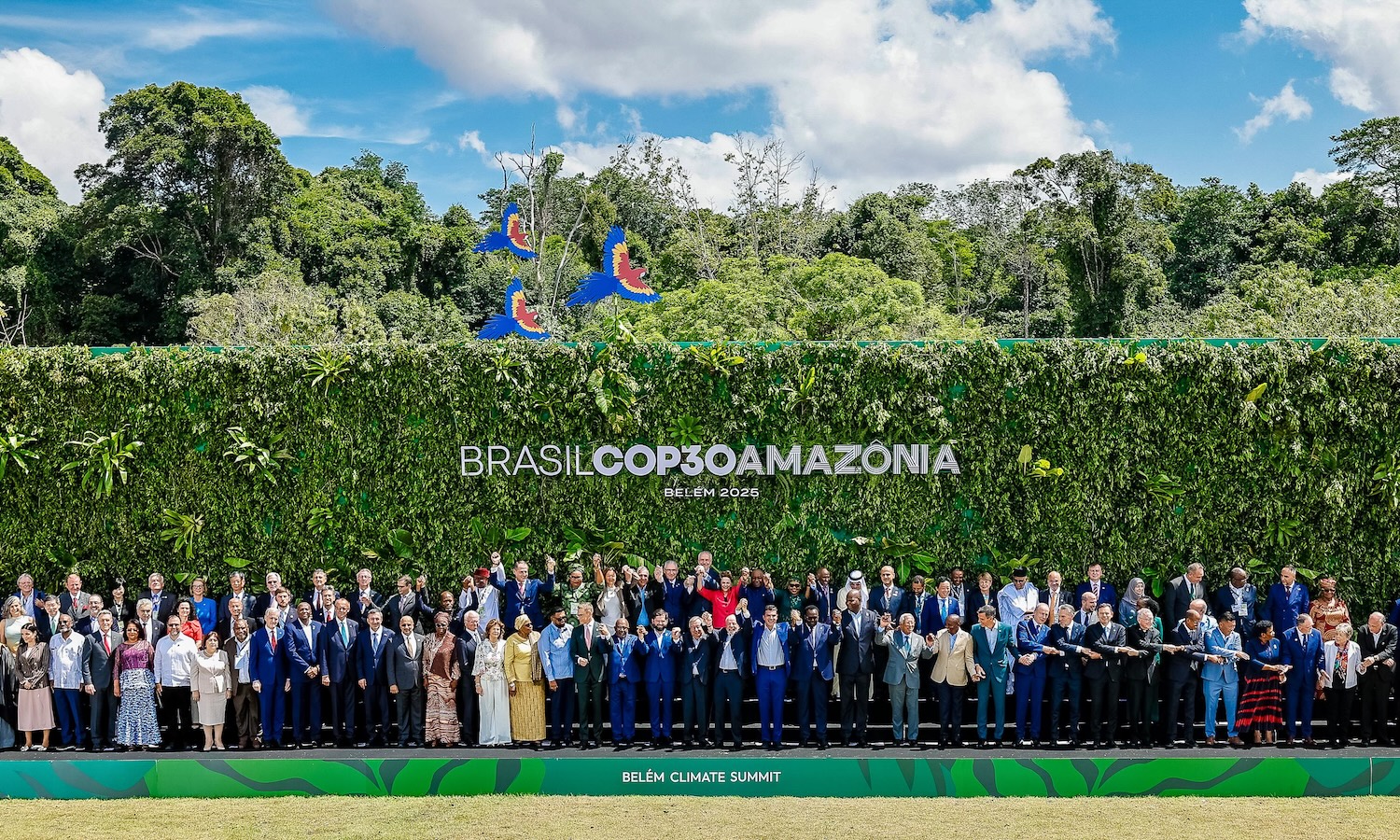
Last week before the official start of COP30, leaders from 43 countries and the European Union adopted the Belém Declaration on Hunger, Poverty and Human-Centered Climate Action. The declaration calls for climate financing to be rebalanced to, yes, still maintain mitigation efforts, but also significantly scale up investment in adaptation—in strengthening communities’ welfare and resiliency in an irreversibly changing world.
In other words: Finally, we’re seeing what it looks like for global climate diplomacy to grapple with the effects of climate change on people and communities, particularly the poorest and most vulnerable. There are no climate solutions without climate justice.
The declaration was spearheaded by Brazilian President Luiz Inácio Lula da Silva, who also oversaw his country lift 40 million people out of food insecurity over the past two years by centering family farmers and food access in national hunger policy.
“Brazil’s recent history proves that when governments back family farmers and prioritise social policies, hunger falls. It’s good to see this politics reflected in the Belém Declaration, which signals a welcome shift—from shiny climate pledges to real-world impact on people,” says Raj Patel, an IPES-Food panel expert, author, filmmaker, and researcher.
Reading through the Belém Declaration, I was pleased to see that within each subject are several specific action items for countries to consider adopting. It is also interesting to see China, a signatory to the declaration, continuing to step up its climate action while other large emitters like the United States, India, and Russia did not join the declaration.
(In fact, the U.S., along with Afghanistan, Myanmar and San Marino, are the only countries not to register a delegation here at COP30, which is truly a shameful abdication of responsibility.)
I think Raj is right, but I want to push back just a little: In my view, the Belém Declaration still does feel like a pledge; just a better one. What we actually need to see—desperately!—is investment. Action. Countries need to put their money where their mouths are.
Or, we just have to stop holding our breath! We’ve seen time and time again that many rich countries, especially the U.S. in recent years, are increasingly unwilling to pay their fair share. So maybe it’s time that we roll up our sleeves and get the work done ourselves.
A very interesting high-level climate finance report that just came out yesterday outlines “a comprehensive and feasible pathway” for developing nations to themselves mobilize the approximately US$3.2 trillion-per-year investment they need by 2035 to meet climate and development goals.
It’s not easy, of course, and we’ll need other stakeholders—like The Rockefeller Foundation, which just announced yesterday that they’ll invest US$5.4 million to support regenerative ecosystems connected to Brazil’s school meal programs—to step forward.
But a better, more equitable, more nourished world is possible. And COP30 is a crucial step toward building that world. So let’s keep our eyes on Belém over the next week and a half.
News Stories/Reports I’m Reading Today:
- Food at COP: Trojan Horse for Climate Action — Here at Food Tank, Fabrício Muriana, a Brazilian agroecology organizer, analyzes the impact of the meals served to attendees at COP30, a percentage of which is local or sourced from family farms and Indigenous producers.”
- No Escape II – The Way Forward — In a new report, the United Nations’ Refugee Agency (UNHCR), puts forth four powerful calls-to-action linking climate action with the need to support people displaced by conflict.”
- Mapped: Big Food’s Routes to Influence at COP30 — Investigative research from DeSmog pulls the curtain back on the tactics that industrial food corporations are using to preserve their environmentally destructive business practices.
- Emissions Gap Report 2025: Off Target — With new numbers, the U.N. Environment Programme finds that the climate pledges countries have made under the Paris Agreement have not been anywhere near sufficient to make meaningful progress.
- Embrace ‘Blue’ Foods as a Climate Strategy at COP30, Fisheries Ministers Say — Mongabay published a call from Brazil and Portugal’s respective fisheries/maritime ministers, reminding us how vital aquaculture will be toward climate solutions.
Powerful Quotes From Recent Discussions:
- “How long are we going to stand by and keep turning the thermostat up so that these sort of events get even worse? We need to adapt as well as mitigate, but we also need to be realistic that if we allow this insanity to continue, to use the sky as an open sewer, that some things will be very difficult to adapt to.” — Former U.S. Vice President Al Gore (via The Guardian)
- “Without financing, food systems transformation is impossible.” — Khaled Eltaweel, Senior Programme Officer, UN Food Systems Coordination Hub
Ways To Take Action:
Follow Local Progress
- via Methane Action Tracker — Learn how your country is making progress to address emissions from livestock and see how your supermarket and favorite dairy and coffee companies are taking action—helping you shop with climate action in mind.
Use Data to Learn
- via University of Leeds — Using new research just published this year, a team of researchers have created a fascinating interactive mapping tool to visualize how tropical deforestation is pushing local temperatures higher.
Keep Tabs on COP30
- via Carbon Brief — Check out this overview of COP30 parties’ positions and priorities to get a lay of the land when it comes to negotiations.
Add This to Your Calendar:
9:30AM–10:30AM [7:30AM–8:30AM ET]:A Food Waste Breakthrough for Climate, Biodiversity, and Equitable, Resilient Cities. @ Axis 4 Thematic Room, Action Agenda Space, Blue Zone: A Food Waste Breakthrough for Climate, Biodiversity, and Equitable, Resilient Cities.
The event marks the official global launch of the five-year Food Waste Breakthrough framework to accelerate interlinked action on food waste, methane mitigation, food security, and resilient urban systems. This in-person event is organized by our friends at UN Environment Programme (UNEP), UN Climate High-Level Champions, ICLEI – Local Governments for Sustainability, and the Global FoodBanking Network.
Food Tank’s official programming kicks off tomorrow, November 14!
At 1:00PM in Belém, we’re hosting “Biodiversity + Soil,” a plenary session highlighting the vital links between regenerative soil stewardship and climate action. Speakers include Sieg Snapp, Michigan State University, CGIAR; Marcela Quintero, CGIAR; Patrick Holden, The Sustainable Food Trust; Eske Willerslev, University of Copenhagen; and Rosinah Mbenya, PELUM Kenya.
Then, at 3:00PM, we’ll continue discussing climate adaptation through soil health in our session “Living Soil, Thriving Planet: Achieving Climate Mitigation and Adaptation goals through Soil Health,” with speakers including Hunter Lovins, Nat Cap Solutions; Merijn Dols, Soil4Climate; and Abdul Aziz, Minister of Environment from Uzbekistan.
At 6:30PM tomorrow night, Food Tank and partners are hosting a UNFCCC Official Side Event, “Nourishing Climate Action: Policy Tools for Climate-Aligned and Resilient Food Systems,” a collaborative discussion with city, national, and global leaders to explore policy tools around food and climate.
We’ll be joined in the evening by speakers including Rodrigo José Abreu dos Santos, Technical Operations Coordinator, Rio de Janeiro’s Secretary of Education; Ivan Euler, Salvador Secretary of Sustainability, Resilience, Well-being, and Animal Protection; Dr. Christopher Browne, CIWF; Duda Salabert, Brazilian Federal Parliamentary Representative from Minas Gerais; Stephanie Maw, ProVeg.
Articles like the one you just read are made possible through the generosity of Food Tank members. Can we please count on you to be part of our growing movement? Become a member today by clicking here.
Photo courtesy of Lula Oficial


